The face of the school: a clerical worker under strain
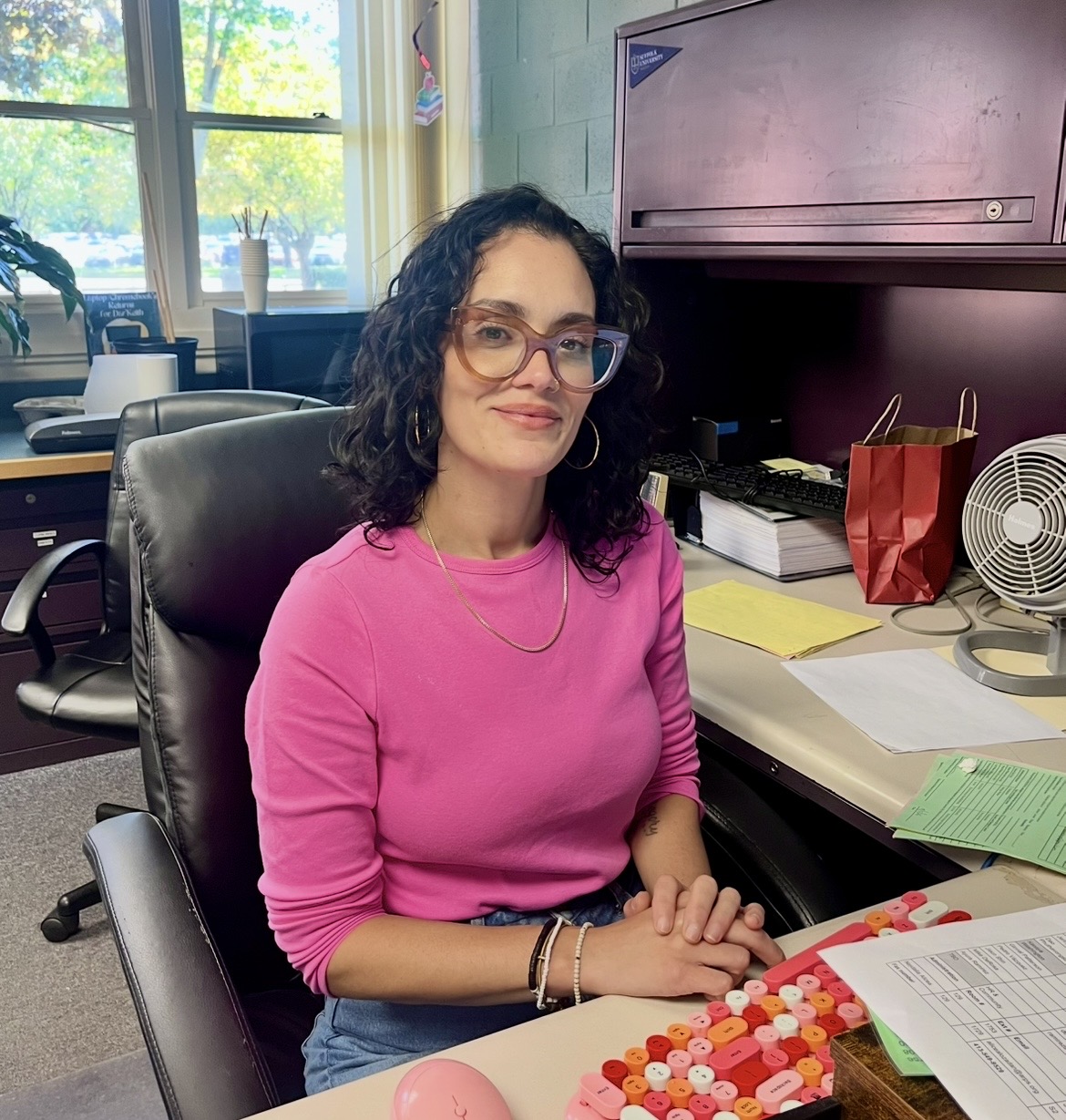
The main office at ARHS is a bustling place. Staff members who have worked here for decades told The Graphic they remember a time when there were a minimum of four dedicated staff members on site: two main office clerical staff, an administrative assistant to the principal, and a registrar, with an additional attendance secretary located in another part of the building. But those numbers are dwindling.
Two years ago, the ARHS office ran with three administrative assistants: one for the principal and two for the main office, as in the past.
But that number was reduced from three to two last year when Chloe Roldan-Guzman moved to an elementary clerical position, leaving Lirey Rodriguez and Jaida Lyons. At the same time, the superintendent eliminated the role of a dedicated ARHS registrar and replaced that position with a district registrar, staffed by Mildred Martinez, located offsite at ARMS. The position of an attendance secretary, staffed by Julie Woyner, was also eliminated.
In an article published last fall (Cuts and consolidation of ARHS clerical staff raise alarm), school staff said the cuts had gone too far. This year, when one clerical staffer took a leave of absence, Rodriguez became the lone main office employee. ARHS is currently the only school in the district with one dedicated main office administrative assistant. Many have three, including the smaller-sized Amethyst Brook.
Former ARHS principal Talib Sadiq was at the high school when “we [first] lost the regional registrar and an attendance secretary, and one of the main office clerical staff members transferred to another position.”
According to Sadiq, “These staffing changes left a substantial void. As a result, the responsibilities of Lirey, Jaida, and Wilnelia expanded considerably. They had to absorb additional duties while continuing to manage their existing responsibilities and ensure the office operated as smoothly as possible.”
Sadiq said that last year it became clear to him that “having sufficient clerical support is critical to maintaining efficient operations, making sure data is recorded accurately, [and] allowing staff members to manage their responsibilities without becoming burnt out.”
For Rodriguez, the situation this year is even more dire, and she feels more overworked and underappreciated.
Rodriguez has worked at the school for around eight years. Students may know her as the voice they hear over the loudspeaker, the smiling face they meet in the office, or the person who stamps their passes and says goodbye as they sign out, as she sips a Mango Pineapple Refresher from Dunkin’.
Filling the main office clerical position alone has been “incredibly stressful,” Rodriguez said. She handles checking students in and out, communicating with parents, tracking attendance, answering incoming phone calls, assigning sub coverage for teachers and paras in the building, clocking paraeducators in and out, producing daily announcements, distributing mail, ordering and distributing supplies, and being the dedicated administrative assistant to the principal. She also plays an active role in making sure major school events, like graduation, go off without a hitch. Doing this alone, she said, feels impossible.
“I’m not the face of what should be the main office,” she said, given that her attention is often drawn to things outside of managing the flow of traffic in and out of the main office. “I have my own responsibilities [beyond that]. We need someone that’s there, and that’s present.”
The stress Rodriguez faced during the start of this school year was unprecedented, she said, and it affected her mental health and her ability to take care of herself, leading her doctor to suggest she take a leave. The week of September 14, Rodriguez was out for three days, and she was also out the following week.
Without any staff member in the main office, Athletics administrative assistant Georgia Malcolm began covering the office and created a daily spreadsheet to assign substitutes to teachers.
On other days, Athletic Director Victoria Dawson stepped in to help. Other clerical staff members, including Judi Dellamarco, the administrative assistant to Assistant Principal Samantha Camera, also began assigning substitute coverage. Guidance administrative assistant Wilnelia Melendez and retired PE and health teacher Elizabeth Haygood also chipped in. Despite this additional support, Rodriguez said she and Melendez are the only two who know how to properly run the office.
Rodriguez said the main office is responsible for serving approximately 800 students and 130 staff members, making the workload difficult for one person to manage. “No plan is being made [to fully staff] the high school main office,” she said. “I don’t feel supported in any way.”
She also said her stress has affected her quality of work and how she interacts with others. “It’s something I’m actually so upset about, that I can’t give my all to everyone,” she said. “Sometimes when you’re so overwhelmed with everything, you come off the wrong way, and I feel like that’s been happening a lot this year. My work quality isn’t meeting my standards.”
Rodriguez refers to herself as the main office administrative assistant and also an “operational member” of the school.
Although Rodriguez has taken on extra responsibilities beyond her original position, she said she has not received additional pay for those responsibilities, aside from overtime when applicable. She started the school year doing overtime every day and on weekends and logging these extra hours. Eventually, she said, the additional work became too draining to continue trying to handle it this way.
“In this economy, any extra money is worth it, but mentally and physically it’s very exhausting,” Rodriguez said. “I’ve been burning myself out, and I have a family and a son.”
She added, “I’m able to help everybody else out and back everyone up, but no one backs me up.” With fewer people available to handle the office, Rodriguez said she has had to put some of her original responsibilities on hold, such as purchase orders, budgeting, accounts, and things that require future thinking and planning.
And she said her own needs have been deprioritized. “I don’t take a lunch break. I go to the bathroom running and coming back,” she said. “I don’t have anyone who can back me up during those times at all.”
When talking about why Rodriguez stays, she said she does it for the students. However, Rodriguez said that continuing to put the needs of others before her own is becoming increasingly difficult.
“I stay because I love what I do and I love where I work and I love who I work with and I love our students,” she said. “I am from here; I am a product of this community.”
Her request is simple: she wants the main office to return to having two full-time clerical positions. Rodriguez said this is her second year reaching out for help, meeting with HR and keeping the union abreast of what is occurring.
“It’s the same thing every year; nothing really is happening. I don’t see any urgency,” she said. “I don’t see that they understand the fact that we’re a busy high school and we graduate students.”
Sadiq weighs in
Sadiq, who is now a counselor at Amethyst Brook Elementary, said he does “not believe it is reasonable or sustainable for Lirey to manage the main office alone or rely solely on a rotating substitute for coverage.”
“The main office handles numerous time-sensitive and essential responsibilities that require familiarity with the school’s daily operations,” he said. “Expecting one person to manage all of these functions without reliable support creates an unnecessary burden and increases the risk of delays, errors, or important tasks being overlooked.”
Furthermore, he noted, Rodriguez “would need to spend valuable time explaining procedures and training substitutes, taking time away from her own responsibilities. A rotating substitute model does not provide the consistency or institutional knowledge needed to ensure the office functions effectively.”
Amethyst Brook, where Sadiq works, has just under 300 fewer students than ARHS but is fully staffed, he said, confusing him as to why the high school, which is significantly larger, has not received the same level of support.
“Amethyst Brook currently has two main office clerical staff members and the principal’s administrative assistant supporting the main office,” he said. “This staffing structure seems to provide an appropriate level of coverage to manage the school’s daily administrative responsibilities and respond to the needs of students, families, and staff.”
According to Sadiq, the high school serves a larger population of students and staff and has to manage a wider range of administrative, attendance, communication, and operational responsibilities. At a minimum, he believes “the high school should have clerical staffing comparable to Amethyst Brook. This would provide appropriate clerical support and help create a more sustainable workload for existing staff and ensure the main office can effectively meet the needs of the school community.”
District response
When asked about the current situation in the high school’s main office, Superintendent Xiomara “Dr. Xi” Herman said the district cannot hire another person in place of the staff member who is on leave, because she still technically works at the school even though she is not currently there. “As long as there remains an absence, there [can only] be a substitute until that person returns,” she said.
Jennifer Ortiz, the director of Human Resources, also met with The Graphic to address Rodriguez’s complaints. She said that she herself started in a clerical role at the high school “many many years ago.”
“There’s super busy periods, and if you feel overwhelmed or if you feel like there’s a lot going on and you’re being pulled in multiple directions, we’re only human, right?” Ortiz said. “And so we try to, you know, power through and do what we have to do.”
But Ortiz also said that she and Dr. Xi had met with Gomes and that “we are aware of it and we’re working towards correcting [it].”
Ortiz confirmed that “if there’s an absence at the building level, the principals or a clerical may assign someone from a sub pool to cover that absence.”
Rodriguez said that she was working alone until she herself entered a clerical sub in Red Rover (the substitute portal) for clerical support, which was filled by Margarita De Jesús, one of a small number of district clerical subs. However, because De Jesús is a substitute rather than a regular employee, she has not had access to PowerSchool (the student schedule and teacher attendance program) or Red Rover (the substitute portal) and has needed Rodriguez’s help logging in every time she performs a task requiring that access.
Herman said that over the years, when budget cuts occur, the district tries to “stay away from cutting teachers” and instead supports students to the best of their ability. “The primary role is to make sure that the school operates well for students,” she said. “We will look at what we can do to provide front office support, but it’s about [general] high school support.”
Even though Herman said she did not want to invalidate Rodriguez’s experience throughout this school year, she said she believes there is a difference between Rodriguez’s account and what the district understands to have happened. “It’s pegging what is happening versus what she’s saying happened. And I don’t ever like to make it seem like I am combating the perspective of an individual,” Herman said.
Herman said she reached out to other superintendents to see how their high schools function, focusing mainly on clerical staff. She came to the conclusion that many high schools, including some larger than ARHS, function with a smaller clerical staff and ARHS should be able to do so as well.
She also believes that clerical staff members could do job-sharing, whether assigned to the main office or not, to support the front office. She said that when staff members outside the clerical staff step in, that should also be okay. “In a school community,” she said. “A lot of times individuals come together so that the school can function well.”
At the same time, Herman said she is continuing to study the situation. “As a superintendent, I’m committed to supporting the schools. We’re going to work with the school team to determine a plan for how we can best support,” she said.
Union’s Perspective
Chris Herland is an English teacher and the president of the APEA (Amherst Pelham Education Association), or teachers’ union. The APEA represents teachers, clerical workers, and paraeducators in the Amherst-Pelham schools.
Herland is very passionate about his role and has many goals. One of the things he prioritizes is the collective voice of organized labor. “I’m not speaking as Chris Herland, I’m speaking as over 500 other people,” he said.
Herland said the union is there to support the school, staff, and students, and that something has gone awry when students start worrying about what is happening behind the scenes for staff. “Students should come to school to do school. You shouldn’t be worried about what the working conditions are like for the adults here,” he said.
When asked about his position on what is occurring in the main office, Herland said “more people are needed in the main office,” and he’s “confused why that is not occurring.”
“The point is we have job descriptions, and we have positions. If you eliminate a position, you’re not eliminating the work that needs to be done. You’re saying to someone else, you have to do this too,” he said.
He repeatedly emphasized that there is more work than there are people to do the work and that this is “demeaning.” Herland believes that people should instead be trained, supported, and uplifted for the work they do.
Herland said he has good conversations with the administration, but that “those conversations do not lead to anything.” He also said that a “budget is a statement of priorities.”
Herland said that the idea that there is not enough money to employ more clerical staff or fully fund the schools could also be resolved. For example, he said that Amherst College, which has an endowment of over 3 billion dollars, is exempt from paying local property taxes. Many colleges with this status pay hundreds of thousands to millions per year to public schools in neighboring towns, but Amherst College commits to occasional gifts rather than a yearly pledge.
Herland believes in Payment In Lieu Of Taxes (PILOT), whereby Amherst College would commit regular payments to the Amherst-Pelham Schools, because if not for its exempt status, the college would owe 18 million dollars to the town annually.
“Why is there only one clerical person in the front office? It’s not crazy to say, well, it’s because Amherst College doesn’t pay their fair share,” he said. “They’re sitting on huge amounts of cash while the communities that they live in are suffering.”
In his opinion, progressive systems should be put in place, and an adequate workplace would have a person for every job.
Herland believes that across all sectors of the economy, working people everywhere are being asked to do more with less, reflecting a much larger issue worldwide. “The front office is a symbol of a universal problem,” he said.