UMass art major (and ARHS grad) Zuleica Booth talks about studying art in college
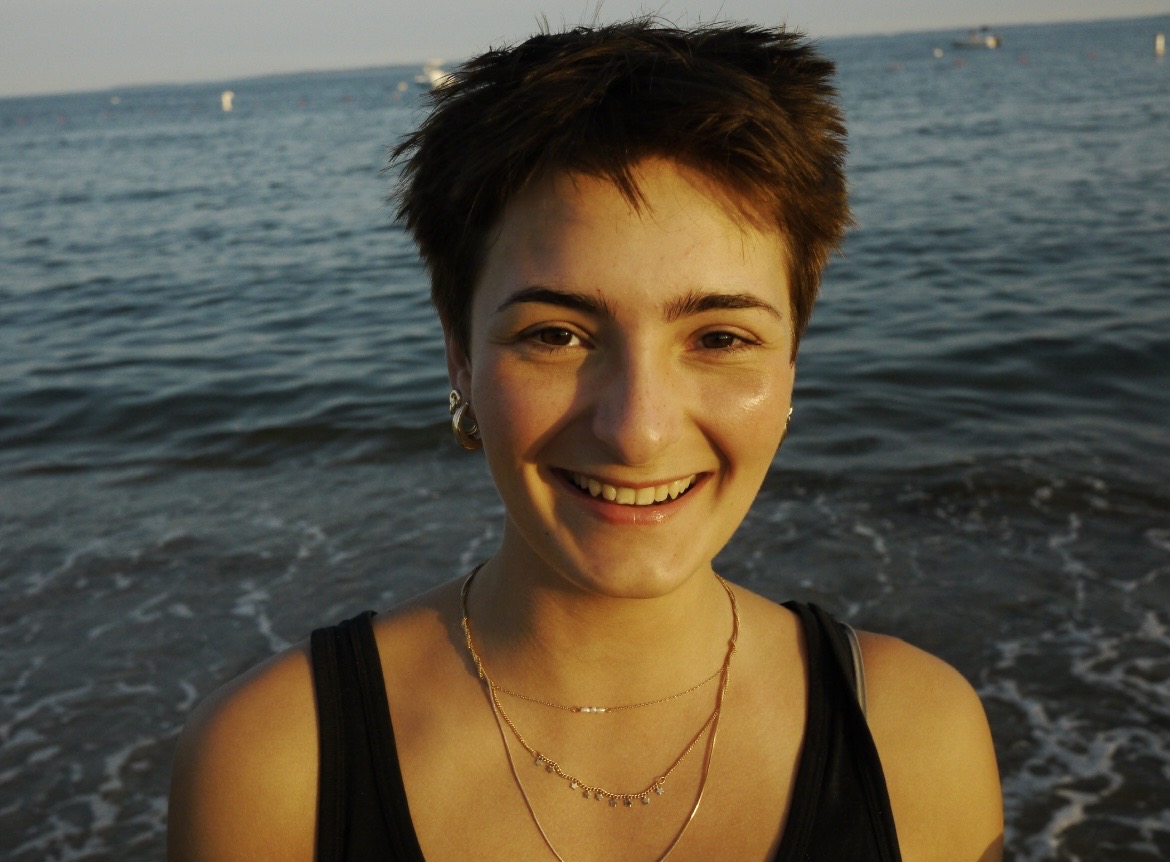
ARHS grad Zuleica Booth (2025) loved art in high school and knew she wanted to go to art school to pursue her love of painting and creating. We had a call to chat about her first semester studying art at UMass Amherst, to hear about her classes and what it’s like to continue after ARHS in advanced art study.
Lorena: What is your major or majors if you have one/two?
Zuleica: Bachelor’s in fine arts; however, I’m pretty sure I will minor in art history.
Lorena: What art medium is your focus?
Zuleica: Well, I don’t have a medium focus as of right now because I’m in my freshman year, and they do basics right now, but I will be going into a focus of painting.
Lorena: What kinds of classes did you take, and what did you learn?
Zuleica: I just finished a semester, my art classes were a compositional drawing class and a studio scale design class. Then I took an art history class, which was a survey class, meaning it just covered a very large period of time. And then I took a freshman year seminar, which every freshman has to kind of take and get over with.
My composition drawing class was a lot of sketches, trying out different compositions of different objects. We did live models [and] a bunch of different still lives. In my design class, we focused on design principles, like the Gestalt theory. One of the principles we learned about was that if you see three lines kind of making up a triangle, but not connecting, your mind is going to fill in that blank. We learned about a bunch of different design principles, starting with more very basic design principles that were less abstract, and then moving to very abstract pieces.
Lorena: What has been your favorite part of this first semester at school, not just classes–but learning new things?
Zuleica: My favorite class was probably my art history class. [But I also] learned how to rock climb, which I’ve never done before. I joined the surf team club. I’ve just been trying out new things and going to different events, and it’s just been really fun. I feel like since the classes are much easier at UMass, it gives me more time to just go and explore, try different things. And the campus is so big, so I love exploring the campus. It’s really fun.
Lorena: Can you explain what you mean when you say the classes are easier?
Zuleica: In high school, they tell you that college is going to be a lot harder. But to be honest, some of the classes I’m taking are [easier]. In art history, for the final, we had a cheat sheet and the questions [were] to identify different [art] pieces and write short paragraphs about them or compare them to a different piece. Since you have the cheat sheet, it was just so easy.
I would also say it depends on your major. I feel like with the resources that we had at Amherst High School and now going into an art major, I’m overprepared, but it is a lot of fun!
Lorena: What does your daily routine look like?
Zuleica: I’m a commuter student, so it’s different [from residential students]. Also, because I don’t have the same schedule every day, it’s very different from day to day. Sometimes I’ll just have classes in the morning, and then sometimes I’ll just have classes in the afternoon.
Most mornings I wake up, get dressed, and eat breakfast. [Then] I’ll drive in my car to the parking lot. They put our commuter parking lots kind of far away from the campus, so I then walk 10 to 20 minutes to my class. I’ll go to lunch at the dining halls, which are great by the way. Then I’ll go to my studio class, and after I’ll maybe putz around a little bit, do some homework. All of my studio classes are from 1-ish to 4-ish, so they’re much longer than our classes in high school. The rest of my classes have been very short, only an hour or sometimes only for 45 minutes if I’m in a discussion.
Lorena: What were your expectations for art school, and how have they come true or changed?
Zuleica: I would say I thought it was going to be a little bit more, not challenging, but just a little less [of the basics]. One day, one of our teachers taught us how to use a pencil, and that was all we did that day. Some days I’m like, wow, this is really not the level that I thought I would be at, especially coming from Amherst. I feel like that with a lot of things, [for example] when I’m writing essays, [or] reading a peer review. Amherst really gave us all the materials that we could ever possibly need. I think it would be different if I were living in the dorm, because I’m just at home, and I have extra time. I’m not trying to figure out what I’m doing with my dorm or my roommate. [But when I] look at [what the] upperclassmen [are doing in art], then I think that it’s going to get much better.
Lorena: What are you excited about in the future?
Zuleica: I have a painting class coming up. Usually, freshmen are not supposed to take any kind of specialty classes; they’re just supposed to take the freshman classes. I am definitely excited for that painting class, I think it’s going to be much better than the classes that I’m taking right now. I really enjoyed my art history classes; you learn a lot just from the lectures. Even in my science class, we had a lot of lectures. I really enjoy just listening to [them] and learning different things. I would say I’m just excited to be taking different classes in the future.
Lorena: What do you plan to do with an art degree?
Zuleica: You know, that is a really good question. I’m not really sure right now. I feel like this is a bigger question than where you are going to go to college. There are so many resources at UMass that I’m sure I’ll figure out what to do with them. I’ll just make art, and I’m sure something will come along. I’m not really sure right now, but we’ll see.
Lorena: What is your dream job and location?
Zuleica: I would love to live somewhere warm near the ocean, [with] surfing all year long. My dream schedule would be to go to work, go surfing, and then go home and sleep.
Lorena: Why do you think studying art is worthwhile and important?
Zuleica: I would say [studying art is worthwhile] because it’s such an important part of our history, and you see it in everything. It’s really useful to understand where it’s coming from, you know, the possible interpretations that people can have for it. Iconography is all around us, and every human can understand what a picture represents. I think that it is important to understand where those pictures are coming from, where that art is being seen, and why that art is being seen.
We recently did a project on maps. When you think of a map, you think of it showing you where you want to go. But we were thinking of maps in a more abstract way. One of the artists that we looked at, he took these posters from his neighborhood and made art with them. It showed you where that neighborhood was, what advertisements were in that neighborhood, and worked as a map of what you might see [while there]. I think it’s really important to look at that art and see what that message is saying.
Lorena: Where do you draw inspiration for your work?
Zuleica: I like playing and doing outdoor activities, so a lot of my inspiration for my art comes from outside. It’s so beautiful, I love it. The way that the waves curl, or the way that the light hits certain things. I think that’s really pretty. I love taking that and working that into more of an abstract way.
Lorena: Anything else you want to mention or talk about?
Zuleica: I will say one thing. Even though I complained about [some] classes being easy, they’ve definitely opened my mind up to more abstract art. [In high school] I hated doing abstract art, [Ben] Sears [an ARHS art teacher] definitely made me do some [abstract art] where I was like, no, please don’t make me do that.
Now I’m starting to really enjoy it and find some cool ways to do different things with it. I’m glad that I got open to [abstract art] because even though having different studio classes where we, for three [or] four hours, draw a hand in different ways [can be] so painful, it really pushes me to go out and do different things.