Interlink Publishing founder Michel Moushabeck: ‘Gaza is asking us a vital question’ about ‘the future we would like to have for our children and grandchildren’
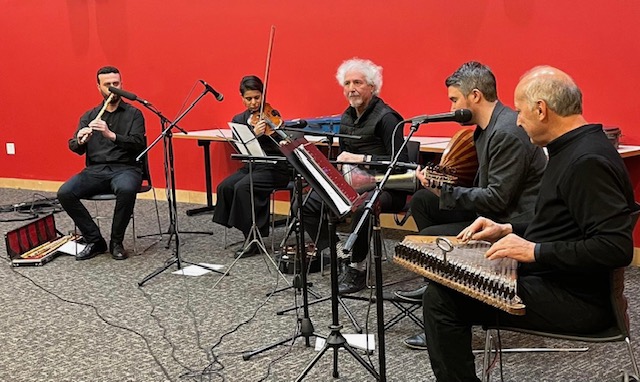
In 1987, a new publishing company sprang up in Northampton, Interlink Publishing, founded by Michel Moushabeck, a writer, editor, publisher, and musician of Palestinian Arab descent who lives in Leverett, Massachusetts. Interlink Publishing is the first and only publishing house of its kind in the English-speaking world and the only Palestinian-owned publishing company in the United States.
Interlink Publishing specializes in bringing “a global perspective to readers.” The approximately 90 books a year it puts out are written by authors from all over the world and translated into dozens of languages, though many of the books focus on the SWANA (South West Asia and North Africa) region, especially Palestine, in genres including history, culture, music, politics, food, children’s, and fiction books.
Nearly 40 years since it began, Interlink is now owned by Moushbeck’s three daughters, Leyla, Hannah, and Maha, and his son-in-law, Harrison, but Moushabeck remains passionately involved in the writing and publishing, and also with his Arabic Music Ensemble. I spoke with him about his work and his legacy, and how he moves forward at a time when so many Palestinian voices are being silenced and censored,
Marit: How many events have you hosted in the last year to highlight Palestinian music or culture in our community, and how did they go?
Moushabeck: Most of our events this past year have been sold out, full houses. We get great, great support from the community. Most of the musicians in my ensemble are based in New York and Boston, so we play all over the United States and all over the world. We also travel for concerts, and we’ve performed everywhere from London to Paris to Singapore. But locally, we have performed at the Bombyx Center for the Arts, and we’ve performed at various colleges. Our last performance was last month at Amherst College, and this month, at UMass. So we play quite a bit locally, and all our events are really well attended. We’ve been doing this for a long, long time, so we have a big following.
Marit: What was your role in organizing the event with Sahar Mustafah, and how are events like these organized? Have you faced any challenges in organizing them?
Moushabeck: My role is the publisher of Interlink Publishing. I’m the founder, the publisher, and the editor of Interlink Publishing, which is a 40-year-old independent publishing house based in Northampton, Massachusetts, and we specialize in a lot of literature in translation. Especially from the Middle East, Africa, and Latin America. We also publish a lot on history, politics, current affairs, and a lot of award-winning cookbooks and illustrated children’s books as well. So in my capacity as a publisher, I organize a lot of book launches. At these launches, I like to include, always, a musical element in order to give people more of a cultural immersion so that when they hear the voices of a Palestinian writer, they will experience the literature as well as the music from that culture. This is a formula that really worked well for us in the past, and it attracts a lot of people to our events.
Marit: Why do you think it’s important to uplift Palestinian voices and Arab voices generally?
Moushabeck: Well, it’s been a struggle over the last couple of years. We’ve seen over and over and over again the silencing of Palestinian voices in the US, especially in academia. And we’ve seen the erosion of academic freedom. There aren’t enough Palestinian voices that you hear in the media, on the radio, telling their own stories. So this is incredibly important to really amplify and uplift those voices and preserve the stories of Palestinians before they fade. This is an important part of what Interlink does. We mentor, we share, we amplify, and we promote voices from marginalized communities. Many of our events this past year, many of our authors, have been canceled. Only last week, we had an author event with two of our authors at the Los Angeles Public Library, and last-minute, the event was canceled because they received a lot of pushback from Zionists in the community, so the library felt they needed to cancel it to avoid any problems. We’ve seen that happen over and over again. A lot of our events have been canceled, and a lot of our authors have been silenced. But we’re still here, and we continue to do what we have to do
Marit: Can you talk about how it feels to be holding space for Arab and Palestinian people to gather during a genocide in their homeland? What are the emotional tones of these events?
Moushabeck: You know, I wake up every morning, and I check the news, and I’m always in pain, in great pain. I have a lot of family members who are there, and I feel sometimes I can’t breathe. It’s just been horrific, that there is a genocide going on in the world and continues to go on. Even though they say that there is a ceasefire, but there is no ceasefire. Palestinians are being killed on a daily basis, and the world watches. So this is, it’s emotionally devastating. It’s horrific that we are not doing more to stop this horror. And I feel that Gaza is asking us a vital question. It is asking us what kind of future we would like to have for our children and grandchildren. It’s asking us to accept what is going on in the world, the horror, the occupation, the atrocities, the harsh conditions, the malnutrition, the amputees, the daily bombings. It’s asking us whether we accept all this, these endless wars, or do we stand up and be united and fight for change. I feel that this is an important period for us, an important juncture. And Gaza is really making us feel as to whether we are going to allow Trump and Netanyahu to get us further into the darkness and into the abyss of hatred and endless wars. Or whether we really feel that we should stand up and fight for change.
Marit: With these events, have you been able to raise any money or raise awareness for Palestine?
Moushabeck: Well, we certainly are raising a lot of awareness for the plight of the Palestinians; these are really antidotes to a lot of the misinformation and disinformation, and all the lies that we see about the struggle for Palestinian rights. Palestinians, all they’re asking for is equality and freedom like everybody else. They want to live in their homeland with equality and freedom. And it’s not a conflict. It’s not a religious conflict. It is not a conflict between Muslims and Jews. It is strictly a colonization that needs to end, and until Palestinians get freedom and equality, I don’t see that there will be any peace anytime in the future. In the region and in the world.
Marit: What is it like to be a part of the publishing and writing world during a time when Palestinian people are being silenced and murdered, especially journalists and writers?
Moushabeck: I have to say, indie publishers and indie booksellers are doing so much to raise awareness. They are fulfilling their responsibility as far as informing the public. Publishers are publishing books, indie publishers specifically, are publishing books that really encourage informed debate, and books that allow, whether it’s activists or students, or the general public, to be more informed so that they can be more active in our democracy than being silent observers. So they are doing amazing work at this particular time. Especially booksellers and librarians as well. They are getting a lot of pushback. From the government, from their communities, and harassment, but they are standing firm and really fighting for what they believe is the truth and the right for freedom of expression and freedom of speech, which is something that we’ve seen getting eroded. We are witnessing today our cultural and literary ecosystems coming under threat. Every single day, we hear of policies and executive orders that are shaking the foundations of our cultural life in the United States. So we have to do what we have to do as responsible citizens, as independent publishers, as librarians, as booksellers, and as readers as well.